Brain4Sight: New Answers for Unexplained Eye and Brain Disorders
The Challenge: When a “Negative” Test isn’t the End of the Story
A negative result means the coding sequences of the known genes have been read letter by letter and nothing is wrong with them. However, genes don’t switch themselves on. That job belongs to regulatory elements called enhancers, which tell a gene when, where and how strongly to be active during development.
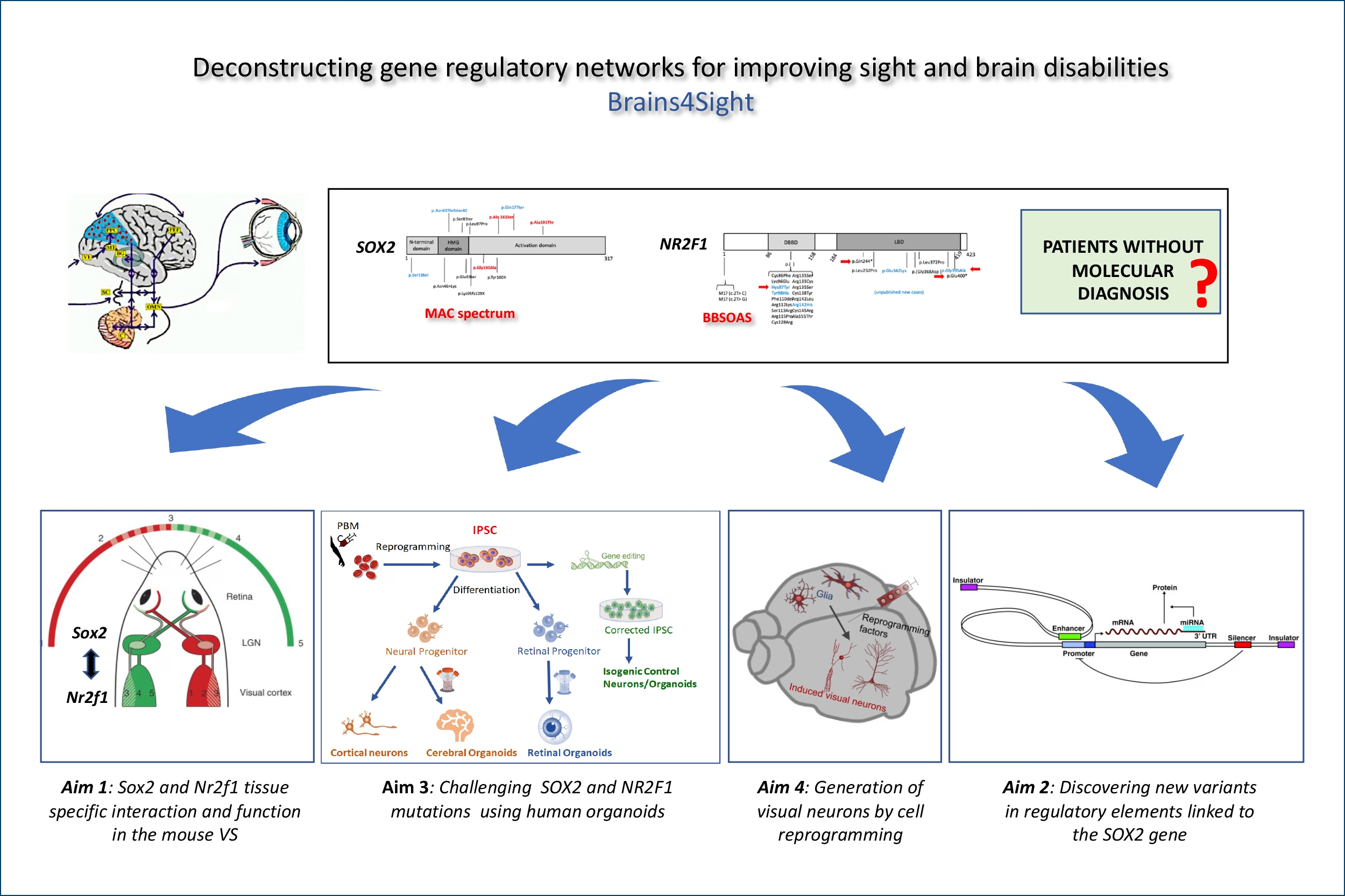
“In Brain4Sight, we asked whether some of the unexplained cases of MAC could carry disruptions in the enhancers that control SOX2 expression,” says Prof. Paola Bovolenta, the project’s coordinator, from the Centro de Biología Molecular Severo Ochoa in Madrid. SOX2 is responsible for around half of all diagnosed MAC cases. Studying a cohort of nearly 200 patients, the team found small DNA changes that left the SOX2 coding sequence completely intact, but disrupted enhancers physically connected to it, as well as to other genes important for vision.
Tested directly, in zebrafish and in patient-derived cells, several of these enhancers turned out to be active switches controlling gene expression in the eye or brain. The team went further still, using CRISPR-based tools to silence the switches at their normal location in the genome. “Enhancers act on one or more of the genes located at some distance from them on the same DNA strand of the genome, within the context of their genomic location; to uncover their effects on gene activity, which are often multiple and unexpected, they must be silenced at this location,” says Prof. Silvia Nicolis, co-principal investigator of the Italian unit, conducting these experiments at the University of Milano-Bicocca, in collaboration with Prof. Bovolenta’s team. The result of targeted enhancer silencing: reduced activity in some genes known to matter for vision, and strong evidence that these non-coding regions are not just bystanders but potential drivers of disease. Causality isn’t proven yet. But for a family with no answer for their child’s condition, this finding may open a door: not a cure, but a clearer path towards a diagnosis, and the ability to plan and counsel accordingly.
One Gene, Many Faces
A parallel puzzle concerned NR2F1, a gene whose mutations cause Bosch-Boonstra-Schaaf Optic Atrophy Syndrome (BBSOAS), a rare condition associated with visual impairment, developmental delay, seizures and intellectual disability. Patients with mutations in the same gene can be affected very differently from one another, and nobody quite knew why.
The Brain4Sight team found part of the answer: different mutations in NR2F1 don’t simply switch the gene off. They disrupt its normal activity in different ways, in different cell types, and at different points in development, which helps explain why two people with mutations in the same gene can end up with such different symptoms.
“The key point is that NR2F1 mutations do not simply cause a loss of NR2F1 function,” explains Dr. Michèle Studer, who leads the French arm of the consortium at Université Côte d’Azur in Nice. “Different mutations can perturb developmental programmes to different degrees and in different cell types and developmental windows.”
Studer’s team tested this directly: building mouse models carrying the exact mutations found in patients, and growing “retino-cortical” organoids (miniature, lab-grown models of retina and cortex) to study the same mutations in a human developmental context. Across both systems, different mutations produced distinct effects: some altered how the retina develops its regional identity, others affected brain development and the function of neural circuits. The clinical variability of BBSOAS, the team believes, comes from this combination of variant-specific effects and each cell type’s differing sensitivity to NR2F1 levels. It’s a first step towards explaining, not just describing, the wide range of ways BBSOAS presents. The team’s mouse-model findings are reported in Disease Models & Mechanisms (Maass et al. 2025) and in Neurobiology of Disease (Deloulme et al. 2024). Studer and Nicolis’s teams found, by the joint study of their mouse models, carrying NR2F1 (Studer) or SOX2 (Nicolis) mutations specifically in thalamic neurons, how SOX2 and NR2F1 jointly shape the developing visual thalamus by co-regulating a wide array of genes active in thalamic neurons. This work, published in Biology Open (Serra et al.), highlights how the diseases caused by mutations in SOX2 or NR2F1 may have at least some common origins in shared target genes for the two transcription factors, pointing to possible future hypotheses to mitigate both diseases. The demanding but much-enjoyed travel of PhD student Linda Serra between the two laboratories has been a welcome added benefit to this research, and to Linda’s training in an international research dimension. Finally, six new patient-derived induced pluripotent cell lines (iPSCs) have been published in Stem Cell Research (Bertacchi et al., 2026).
Exploring Future Therapeutic Possibilities
Two proof-of-concept results push Brain4Sight’s findings from mechanism towards future treatment.
The first addresses a long-standing question in regenerative medicine: can the brain’s own cells be coaxed into replacing neurons it has lost? The German partner, led by Prof. Benedikt Berninger at the University Medical Center Mainz, has spent years working on turning astrocytes, a type of support cell in the brain, into neurons (Marichal et al., 2024). Within Brain4Sight, his team showed that delivering specific “reprogramming” proteins directly into the visual part of a mouse’s brain could transform astrocytes into visual neurons. When the mice were then shown moving visual patterns, the newly made neurons responded. Some could even tell which direction the pattern was moving, implying that they had integrated properly into a visual circuit. “The long-term concept is exciting because it suggests that, in principle, a brain’s own resident cells could one day be used to replace neurons lost to injury or genetic disease, without needing to transplant anything from outside the body,” says Bovolenta.
The second result tackles SOX2-related disease at its genetic root. The Italian partner, Dr. Silvia Russo, took cells from a patient carrying a disease-causing SOX2 mutation, reprogrammed them into stem cells, and used CRISPR-Cas9 to correct the mutation. Corrected and uncorrected cells were then grown in conditions that encourage stem cells to become retinal ganglion cells, the neurons that carry visual information from the eye to the brain. Only the corrected cells reached normal levels of the proteins those neurons should produce. “This result represents a proof-of-concept that a single, precise genetic correction can put a real patient cell on the right track towards generating specific neuron cell types,” Bovolenta explains. There is still a long road between this result and any therapy. But it is a concrete, necessary step, establishing that correcting SOX2 is, in principle, capable of improving developmental alterations. A CRISPR-based genetic screen of 120 genes regulated by SOX2, of previously unknown function, led by the Italian team, discovered several genes that are important for the in vitro development of human brain organoids (Pozzolini et al, bioRxiv, doi: https://doi.org/10.64898/2026.10.23.761353). The identification of genes acting downstream of the disease-causing gene (SOX2 in this case) may hopefully lead to strategies for their future pharmacological modulation, to ameliorate aspects of the disease.
Teamwork: The ERA-Net NEURON Advantage
Brain4Sight brought together four countries, each contributing expertise the others did not have. Spain (coordinator, CBM-CSIC/UAM) led on eye and retinal developmental biology, generating human retinal organoids and testing candidate enhancers in zebrafish. France (iBV, Nice) brought deep expertise in mouse genetics, building the patient-specific NR2F1 models and retino-cortical organoid protocols, along with the electrophysiology needed to record their activity. Italy (Istituto Auxologico Italiano and the University of Milano-Bicocca) connected the consortium to Italian patient registries such as OMAR and contributed mouse (in vivo) and human (in vitro) genetic models of SOX2 deficiency, human genomics, patient-cohort analysis and expertise in SOX2 function. Germany (University Medical Center Mainz) brought its pioneering direct-reprogramming technology, converting resident glial cells into functional visual neurons.
“ERA-Net NEURON funding let us build a genuinely complementary team that no single national grant could have assembled,” says Bovolenta. The four partners worked on the same underlying question, how SOX2 and NR2F1 mutations produce a spectrum of eye and brain phenotypes, using different experimental systems in parallel and cross-checking results against one another. An enhancer discovered in Italian patients was tested in zebrafish in Spain. Organoid phenotypes generated independently in Spain and France were compared side by side. “This cross-validation gave us much greater confidence in our findings than any single laboratory could have achieved alone, and would not have been logistically or financially feasible without a coordinated multinational grant,” she adds.
Listening to Patients, Reaching the Public
Brain4Sight’s partners stayed in close contact with the families their research is ultimately for. Through patient registries such as OMAR and direct conversations with families and patient advocates, one message came through loud and clear: parents wanted to understand why children with the same diagnosis could be affected so differently. “These conversations reinforced the importance of going beyond describing NR2F1 variants and building models that can explain the clinical heterogeneity of BBSOAS,” says Studer. Patient advocates, she adds, have expressed a strong hope that understanding the disease mechanism will eventually lead to more personalised approaches to diagnosis, monitoring and, further down the line, treatment.
The Italian team also took the project’s science beyond the lab, staging a theatre play on the genetics of neurodevelopment with the University of Milano-Bicocca’s “RicercAttori” troupe (RicercAttori is a pun based on the Italian word Ricercatori, meaning Researchers, and the words Ricerca = Research, and Attore = Actor). The play, titled “La sostanza di cui sono fatti i sogni” (“Such stuff as dreams are made on”, referring to the brain’s neurons), was performed for more than 300 high school students and teachers and around 100 members of patient and family associations. After the first performance, the team received a letter from a mother and patient-association representative, asking whether one of the stories told on stage (a severe genetic brain disorder reversed in a mouse model after birth) was “really true.” She later wrote publicly that genetic diagnosis was worth pursuing even without a cure in hand, because understanding a disease’s mechanism can still, eventually, point towards ways to ease it. The play has since been invited back for repeat performances in Milan, Turin and Catania.
Looking Ahead
Brain4Sight leaves behind a shared gene-regulatory map of the visual system, new preclinical models, and two proof-of-concept results pointing towards future therapy. Between them, these outputs are a resource other clinicians and researchers can draw on as they keep searching for what causes, and what might one day treat, the eye and brain disorders at the heart of this project.
“No single lab could have taken this problem from mouse genetics to human organoids to gene correction on its own. Brain4Sight showed what four teams across Europe can do when they trust each other, share input and information and advance together. I hope this can be a model for how we tackle rare neurodevelopmental disorders going forward.”
Brain4Sight’s contributions extend to the people it trained, too. Early-career researchers also played an important role in its scientific achievements, contributing to the research while developing their expertise through international collaboration. One example is PhD student Giorgia Pozzolini, whose research was recognised with three Best Poster Awards at international conferences in Japan, Italy and the United Kingdom in 2025 and 2026.
Publication highlights:
- Maass et al. “Models of Bosch-Boonstra-Schaaf optic atrophy syndrome reveal genotype-phenotype correlations in brain structure and behavior.” Dis Model Mech. 2025 Oct 1;18(10):dmm052426. https://doi.org/10.1242/dmm.052426
- Bertacchi et al. “Generation of BBSOAS patient-specific induced pluripotent stem cell lines harboring six NR2F1 pathogenic variants.” Stem Cell Research. 2026 Mar 10;93:103950. https://doi.org/10.1016/j.scr.2026.103950
- Marichal et al. “Reprogramming astroglia into neurons with hallmarks of fast-spiking parvalbumin-positive interneurons by phospho-site-deficient Ascl1.” Sci Adv, 2024. https://www.science.org/doi/10.1126/sciadv.adl5935
- Serra et al. “SOX2 and NR2F1 coordinate the gene expression program of the early postnatal visual thalamus.” Biology Open, 2025. https://doi.org/10.1242/bio.062014
- Deloulme et al. “Structural interhemispheric connectivity defects in mouse models of BBSOAS: insights from high spatial resolution 3D white matter tractography.” Neurobiology of Disease, 2024. https://doi.org/10.1016/j.nbd.2024.106455
- Cardozo, Sanchez-Bustamante & Bovolenta. “Optic cup morphogenesis across species and related inborn human eye defects.” Development, 2023. https://doi.org/10.1242/dev.200399
- Morabito et al. “2D and 3D human in vitro models: a platform to explore the impact of SOX2 hemizygosity on nervous system development.” Eur J Hum Genet., 2025, 33 (suppl 1), Abstract presented at the 58th European Human Genetics Conference (ESHG), Milan, Italy, 24–27 May 2025. https://doi.org/10.1038/s41431-025-01935-5
- Pozzolini et al. “An improved CRISPR-LICHT screen of 120”Tdark” genes illuminates new biologically relevant SOX2 targets in human brain organoids”, under revision, bioRxiv 2026.10.23.761353. https://doi.org/10.64898/2026.10.23.761353
Brain4Sight (“Deconstructing gene regulatory networks for improving sight and brain disabilities”) was funded under ERA-Net NEURON’s Joint Transnational Call 2021 on Neurodevelopmental Disorders, running from April 2022 to May 2026, with support from the Spanish State Research Agency (AEI), the French National Research Agency (ANR), the Italian Ministry of Health (MOH) and the German Federal Ministry of Education and Research (BMBF).