PAINDIFF: Raising the Standard for Sex and Gender Considerations in Pain Research
Pain is one of the most universal human experiences, yet it is far from equal. For decades, clinical and scientific evidence has shown that biological males and females, as well as people of different gender identities, experience pain differently. Despite this, there are still large inconsistencies in how sex and gender factors are examined between research groups, impacting reproducibility of results and the conclusions that can be drawn.
The Challenge: The Hidden Biases in Pain Medicine
In an era that is placing increased emphasis on individuals and personalised medicine, it is equally essential to adopt consistent research methodologies that take into account sex and gender when studying chronic pain. For example, female animals have historically been excluded and continue to be understudied in preclinical research. Furthermore, while both males and females are now largely included in human clinical pain research, few studies examine the influence of sex on their findings. Without a standardised approach to assessing sex and gender in research, we risk producing inconsistent data, failing to replicate studies across laboratories, and ultimately designing treatments that may only work for half the population. To improve methodologies and increase the chances of helping patients, the scientific community needs a clear, practical, and globally accepted approach.
Establishing a Standard within Pain Science
Supported by ERA-NET NEURON Networking Group Call on the topic of ‘Chronic Pain’, the PAINDIFF consortium set out to solve this methodological crisis. The network assembled a highly multidisciplinary team of 32 international experts with expertise spanning preclinical science, human experimental research, clinical pain medicine, and patient advocacy.
The consortium, with equal representation of women and men, developed a set of recommendations and guidelines for best practice for a range of stakeholders in chronic pain research through a three-step process:
- Literature Review: A thorough analysis of existing scientific guidelines was conducted to pinpoint where the largest gaps in sex and gender reporting lay.
- Global Survey: Current practices, biases, and practical barriers were assessed through responses from a cohort of 483 pain researchers worldwide.
- Consensus Conference: International consortium members met in Galway, Ireland, to debate, align, and finalise their recommended guidelines for incorporating sex and gender into pain research studies.
The consortium’s efforts culminated in the publication of a comprehensive 13-recommendation consensus framework in the prestigious journal Nature Neuroscience. These recommendations provide clear, practical instructions to help researchers standardise study designs, perform sex-disaggregated analyses, and report their data transparently to ensure clinical translatability.
A Gap Between Beliefs and Practice
The literature review and global survey provided the first comprehensive look at the biases and constraints currently stalling the routine inclusion of sex and gender in pain research, revealing a gap between what researchers believe is important and what they actually practice in the lab.
On the one hand, there is a near-unanimous agreement on the importance of biological sex, with over 85% of both preclinical and clinical researchers surveyed agreeing that studying biological sex is crucial in pain research. Furthermore, a vast majority of preclinical scientists (81%) and clinical researchers (74%) report that they do, at least sometimes, analyse and report their pain findings separately by sex.
On the other hand, they found that researchers report many constraints and biases to incorporating sex and gender routinely in their research. When it comes to animal testing, only 40% of preclinical researchers routinely include both male and female animals (such as mice and rats) in the majority of their studies. Furthermore, in experiments involving humans, the survey exposed that while biological sex is widely recorded, over 50% of clinical pain researchers rarely or never consider gender, the psychological and social construct, in their experimental design, analysis, or interpretation. When researchers were asked what is preventing them from incorporating unbiased sex and gender approaches in the lab and in clinical studies, researchers cited a lack of specialised training, followed heavily by a lack of financial and physical resources and time. It was noted that preclinical scientists frequently cited a fear of “increased data variability” when using female rodents. However, the PAINDIFF consortium disproves this historical assumption by highlighting meta-analyses showing female rodents are no more variable than males, while establishing that tracking hormonal cycles may not always be necessary to achieving reliable scientific results.
Building Consensus: From Evidence to Recommendations
To turn this raw data into action, the consortium convened for a two-day Consensus Conference in Galway, Ireland. This wasn’t just a series of presentations, but a vibrant and interactive scientific debate. The 32 international partners from diverse fields spanning molecular cell biology, human experimental research, clinical pain medicine, and patient advocacy, debated the findings of the global survey and the literature review.
Achieving a unified agreement required rigorous discussion and intense debate. The recommendations needed to be scientifically robust and thorough, yet highly practical and realistic for busy, resource-constrained laboratories to adopt. Using the Chatham House Rule to encourage open and candid discussion and sharing without attributing comments to individual participants, the partners gradually aligned on common priorities. This intense collaborative effort culminated in unanimous consensus on 13 definitive, highly practical recommendations to improve research transparency, reproducibility, and clinical translation.
A Framework for Future Research
The consensus forged at the Galway conference became the foundation for a landmark scientific milestone: the publication of the definitive, 13-recommendation consensus framework in the prestigious journal Nature Neuroscience.
These recommendations provide clear, practical, and low-burden instructions to help researchers standardise study designs, perform sex-disaggregated analyses, and report their data transparently. Thanks to this unified framework, clinical discoveries stand a far greater chance of translating into successful, personalised treatments for patients.
Below is the complete 13-recommendation checklist established by the PAINDIFF consortium, outlining universal principles alongside specific preclinical and clinical guidance.
The PAINDIFF Consensus Recommendations Checklist
| Category | No. | Recommendation |
| Universal | 1 | Males and females included |
| 2 | Sex accounted for in randomisation, counterbalancing, and testing order | |
| 3 | Study powered for sex differences (not always necessary) | |
| 4 | Detailed reporting of experimental design, including sex of experimenter (when possible) included | |
| 5 | Sex-disaggregated analysis conducted and data reported | |
| Preclinical | PC1 | Sex of cells and/or tissues identified |
| PC2 | Oestrous cycle stage accounted for (not always necessary) | |
| PC3 | Detailed reporting on housing and environmental conditions included | |
| Human / Clinical | H/C1 | Participant’s sex assigned at birth and self-identified gender included in demographics |
| H/C2 | “Prefer/choose not to say” response option included | |
| H/C3 | Textbox response option to capture subjective individual identity included in demographics | |
| H/C4 | Number of people who are gender diverse reported | |
| H/C5 | Sex- and gender-specific variables collected and reported |

Real-World Impact: Driving Uptake of the Recommendations and Shaping Research Culture
Developing recommendations is only the first step. Encouraging their widespread adoption across the global pain research community is the next challenge. This is where the unique composition of the PAINDIFF consortium plays a crucial role.
A particular strength of the consortium is the involvement of researchers who also serve in senior editorial roles within the pain research community. Among its core partners is Prof. Karen D. Davis, the Editor-in-Chief of PAIN, the world’s leading journal in pain research. Furthermore, five other PAINDIFF partners (Drs. Ruth Defrin, Simon Beggs, David Finn, Stefan Lautenbacher, and Herta Flor) serve directly as Associate Editors on the journal’s board.
As scientific gatekeepers, journal editors play an influential role in shaping research culture. Because several of the people co-authoring these recommendations are the very same editors who define standards for peer review and publication, PAINDIFF is uniquely positioned to help move these guidelines from best-practice recommendations towards widely adopted research and reporting standards.
Editors play a pivotal role in shaping research culture: they influence what is considered essential in study design, analysis and reporting, and they can help move good practice from aspiration to expectation.
Overlooked Sources of Sex Bias
The PAINDIFF recommendations don’t just tackle patient demographics- they expose subtle, overlooked variables that actively skew scientific results in the background.
1. Breaking the Cellular “Sex Omission”
For decades, researchers assumed that cells growing in laboratory dishes were immune to biological sex differences, assuming such differences were purely driven by hormones circulating through the body. However, PAINDIFF highlights that the sex of a cell dictates fundamental gene expression, affecting for instance, receptors displayed on the cell surface, and the cellular metabolic pathways. Failing to report whether cells are derived from males or females can cause preclinical discoveries to fail when translated to humans. By calling for cell-line sex transparency, PAINDIFF is addressing a major blind spot in early-stage drug development.
2. The Experimenter Sex Effect
One of the most fascinating aspects of behavioral research is how the presence of a human observer alters animal behavior. A classic example was observed by Prof Jeffrey Mogil and his team, a partner of the PAINDIFF consortium. He noted that when animals were tested by male researchers, they tend to have lower pain-related behaviour than when tested by female researchers, an effect they could attribute to increased stress experienced by the animals in the presence of male researchers – termed stress-induced analgesia. Similarly, clinical research has also noted that the sex and gender of researchers can influence pain outcomes. These data highlight that environmental context is important and should be recorded and taken into account where possible. As such, the consortium’s fourth universal recommendation urges researchers to ethically and transparently report the sex of the experimenters running the studies. Standardising this simple data point will drastically improve baseline repeatability across laboratories worldwide.
The Human Connection: Partnering with Patients
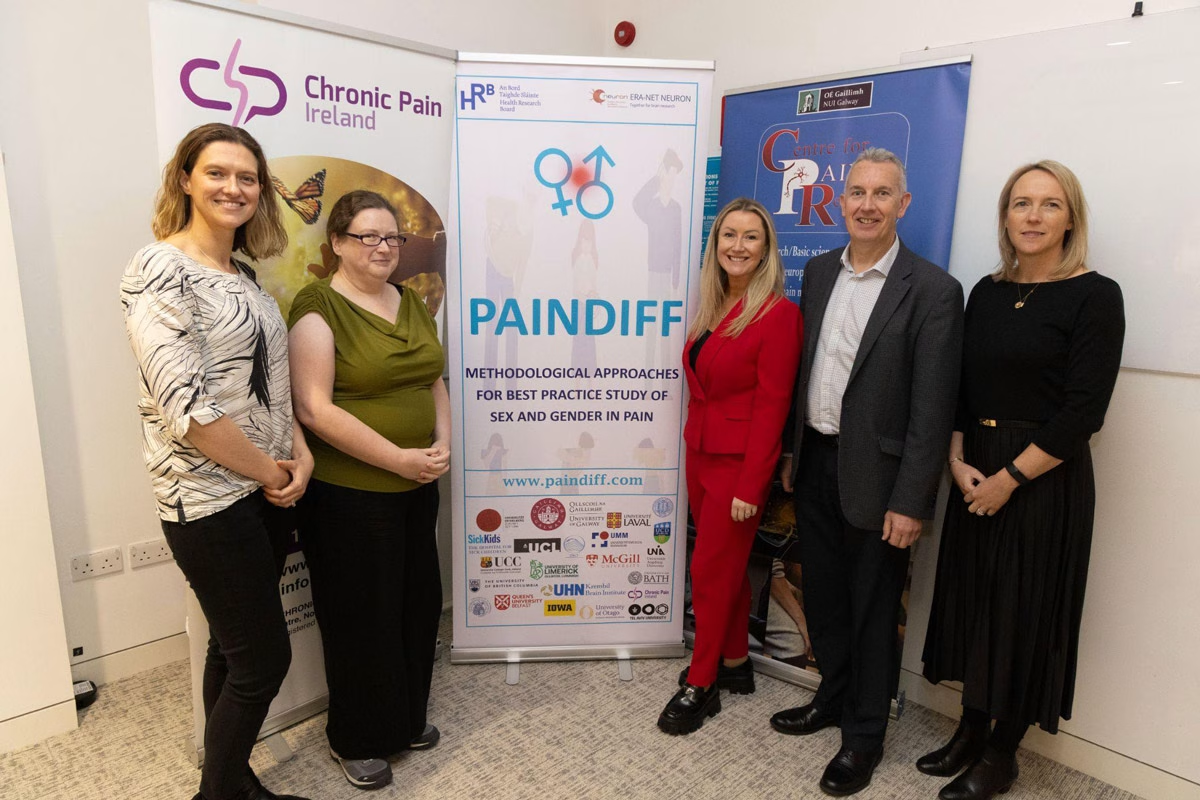
To ensure the consortium’s recommendations were clinically relevant, PAINDIFF embedded patient advocates directly into the network through a partnership with Chronic Pain Ireland. Rather than treating research as a purely academic exercise, patient representatives kept the international scientists grounded in lived experience. They highlighted the historical biases in medical literature, particularly regarding female pain, and pushed for recommendations that would lead to more inclusive, evidence-based, and personalised clinical care.
As part of their outreach, the consortium co-organised a hybrid public-patient event with Chronic Pain Ireland, showcasing basic and clinical research directly to patients while hosting open panel discussions. This collaborative effort bridged the gap between complex molecular science and the real-world needs of people living with chronic pain.
Teamwork: The ERA-NET NEURON Advantage
A project of this scale, which successfully united basic scientists, clinical researchers, methodologists, and patient organisations across borders, would have been virtually impossible to accomplish under standard national funding programs.
National grants are typically confined to single-country borders and limited scientific disciplines. The structure of the ERA-NET NEURON Networking Groups Call provided the exact mechanism needed to build a highly inclusive, international network. It granted the consortium the time, structure, and cooperative resources needed to resolve deep-seated methodological divides, paving the way for a major leap forward in translational medicine.
Moving forward, the legacy of PAINDIFF continues to grow. The network has already generated several high-impact spin-off collaborations, including multiple new Joint transnational research projects funded under ERA-Net NEURON’s Joint Transnational Call on Chronic Pain (JTC2025). By standardising how we study sex and gender, PAINDIFF has built a healthier, more transparent, and highly reproducible foundation for the future of pain research and beyond.
PAINDIFF Consortium Members:
Dr Michelle Roche, Physiology, University of Galway, Ireland
Prof David Finn, Pharmacology and Therapeutics, University of Galway, Ireland
Prof Brian McGuire, Psychology, University of Galway, Ireland
Catherine Healy, Pharmacology and Therapeutics, University of Galway, Ireland
Rebecca Lane, Pharmacology and Therapeutics, University of Galway, Ireland
Eleonora Fetter, Physiology, University of Galway, Ireland
Dr Ryan Brendan Donovan, Psychology, University of Galway, Ireland
Dr. Brona Fullen, University College Dublin, Ireland
Dr. Siobhain O’Mahony, Anatomy & Neuroscience, University College Cork, Ireland
Prof. George Shorten, University College Cork, Ireland
Prof. Kieran O’Sullivan, University of Limerick, Ireland
Dr Ipek Yalcin, Le Centre national de la recherche scientifique (CNRS), France
Prof. Herta Flor, Central Institute of Mental Health & University of Mannheim, Germany
Prof. Rohini Kunar, University of Heidelberg, Germany
Prof. Miriam Kunz, Augsburg University, Germany
Prof. Stefan Lautenbacher, University of Bamberg, Germany
Prof. Edmund Keogh, University of Bath, UK
Prof. Kevin Vowles, Queens University Belfast, UK
Prof. Suellen Walker, University College London, UK
Dr. Simon Beggs, University College London, UK
Prof. Michael Salter, The Hospital for Sick Children & University of Toronto, Canada
Prof. Jennifer Stinson, The Hospital for Sick Children & University of Toronto, Canada
Prof. Karen Davis, Krembil Brain Institute, University Health Network, Canada
Prof. Jeffrey Mogil, McGill University, Canada
Prof. Yves De Koninck, Laval University, Canada
Dr. Katelynn Boerner, University of British Columbia, Canada
Prof. Ruth Defrin, Tel-Aviv University, Israel
Prof. Kathleen Sluka, University of Iowa, US
Prof. Emeran Mayer, University of California, Los Angeles, US
Dr. Hemakumar Devan, University of Otago, New Zealand
Louise Riordan, Chronic Pain Ireland, Ireland
The PAINDIFF project was funded under the ERA-NET NEURON Networking Group Call 2022 framework with support from the Health Research Board of Ireland.